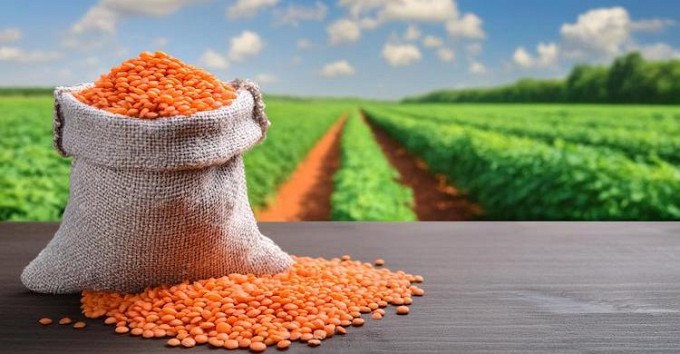
The Food Corporation (FCC) is encouraging farmers to switch to marginal crops and improve the efficiency of agricultural practices. Starting in 2025, the FCC has been accepting applications for long-term forward financing for red lentil production, according to APK News.
The pilot project is being implemented jointly with UNDP as part of the "Promoting Sustainable Agricultural Production Systems and Conserving Landscape Ecosystems in Northern Kazakhstan" program.
The project is aimed at agricultural producers in the North Kazakhstan, Akmola, and Kostanay regions. Applications from agricultural enterprises are currently being selected. The selection process takes into account the farms' commitment to crop rotation, the availability of the necessary agricultural machinery, and a full-time agronomist, as participation in the program requires the mandatory implementation of environmentally friendly agricultural practices and adherence to scientific recommendations.
Financial support includes advance payments for sowing at a rate of 90,000 tenge per ton of red lentils. The mechanism aims not only to expand the cultivation of high-demand crops but also to improve the stability of agribusiness.
According to UNDP experts, the country's northern regions remain highly dependent on monoculture (wheat), accounting for 75-87% of the cultivated area. At the same time, the potential for growing legumes, particularly in the North Kazakhstan region, remains significant.
As Samat Tenbayev, Deputy Chairman of the Board of JSC NC Food Contract Corporation, noted, the industry is demonstrating strong interest in cultivating higher-margin crops, including legumes and oilseeds, which is already yielding tangible results.
Over the past five years, the area sown to legumes has more than quadrupled, reaching 781,000 hectares.
In 2025, Kazakhstani farmers harvested a record legume harvest—almost 1 million tons, with lentils accounting for approximately 78% of the total.
The growth in the gross harvest of pulses has expanded export opportunities. According to the Bureau of National Statistics, dried pulse exports exceeded 570,000 tons, an increase of almost 50% compared to the previous year.
High external demand and an attractive price compared to wheat make lentils one of the most promising crops for farmers.
"Today, the agro-industrial complex faces the challenge of not only increasing production volumes but also ensuring the sustainability of agriculture. Supporting crop diversification and introducing modern agricultural technologies allow farmers to increase profitability. Overall, this approach makes the industry less dependent on market and other risks," noted a representative of the Food Corporation.
With long-term forward financing, farmers receive a guaranteed market and access to working capital.
At the same time, as part of the UNDP project, farms, with the support of Kazakh and international experts, will work to restore soil fertility, adhering to necessary agricultural requirements.
"This mechanism is a practical example of how financial instruments can stimulate the transition to more sustainable and diversified agricultural systems, while simultaneously increasing farmers' incomes and reducing risks for the sector," added UNDP Acting Resident Representative in Kazakhstan, Sukhrob Khodjimatov.