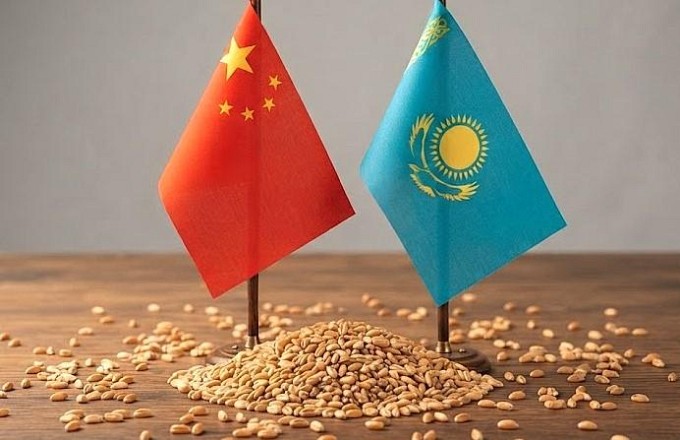
While Russian media reports on the "explosive" growth of grain exports to China, Kazakhstan's agricultural sector is heading toward a major crisis. Beijing, despite its record harvest, is consistently restricting the market for Kazakh feed meal, banning the use of cheap Russian raw materials and leaving only a small niche for high-quality wheat. As a result, blocked western routes, expensive transit through the Caspian Sea, and aggressive dumping of Russian products in Central Asia are leaving Kazakhstan alone, facing the threat of a food impasse, a solution to which will require strict administrative restrictions and billions in subsidies, according to the APK News agency.
The Kazakhstan National Exporters Association, KazGrain, reported yesterday that China has sharply increased its purchases of Russian grain: wheat imports have increased 243-fold. KazGrain CEO Zeinollah Abdumanapov stated: Russia is forcing competitors out of the market by hoarding volumes locked in due to port blockades and by pushing down prices. For Kazakhstan, this poses a direct threat of losing its feed meal export market share.
Following the publication of this article, Yevgeny Karabanov, chief analyst at the Kazakhstan Grain Union, commented on the situation with Russian exports to the APK News agency.
"I agree with the figures, but this is due to the low base of Russian exports from the previous period. Before, we sent three samples, and then we sent a whole carload. This is relative. According to data from the federal center Agroexport, cited by Russian media, the largest revenue for January-July of this year came from barley shipments – over $87 million, corn – over $55 million, and buckwheat – around $45 million. Wheat is leading in terms of growth, with shipment values increasing 24-fold to over $10 million," Karabanov said.
"If we take, for example, the price of wheat at $200, that's a maximum of 50,000 tons in seven months. What kind of wholesale purchase of 'locked-up' Russian grain can we possibly talk about with such volumes? "I want to emphasize that it's important to evaluate absolute figures—the absolute figure for seven months is $10 million. That's just over 7,000 tons per month," said E. Karabanov.
The expert cited the fact that if these figures are from Russian media, they're forced to report them because government agencies need to reassure the market that things aren't so bad in Russia and that grain isn't locked up, and that it will flow, especially since the Russian leader recently announced that Russia will definitely supply 60 million tons to the global market.
"I believe such information is simply a pitch for the people," our interlocutor said.
Is this information from Russia important for Kazakhstan's grain and flour exports?
"No, for me, this news means nothing. Once again: we need to analyze absolute figures, not relative ones. And in this context, anything can be twisted and shown to be quite impressive, even astonishing, growth. "It all depends on what we use as a baseline. This figure of $10 million is the truth, not 243 times. There is an increase in buckwheat, barley, and wheat, but it's based on a low base from the previous period," said E. Karabanov.
When asked by Evgeny Karabanov what could be said about Kazakhstan's situation in China, he replied that he was ready to present an analytical model for his view, but noted that it could be significantly adjusted by external factors.
Firstly, China's self-sufficiency is fully confirmed by recent figures: this summer, China harvested a historic record harvest of food grain—over 150 million tons. Beijing is consistently moving toward absolute food independence and rigorously protecting its domestic market. Moreover, China's recent actions clearly demonstrate that it plans to exploit Kazakhstan for its own interests.
Is China really "closing the door" to Kazakhstan?
- Not exactly. It never opened it wide. Instead of large-scale purchases of wheat and flour, Beijing has introduced strict new regulations that completely deprive Kazakhstani exporters of any room for maneuver:
Ban on Russian raw materials for wheat-barley feed mix:
As part of its fight for clean imports, China has officially banned Kazakhstan from using Russian grain to produce wheat-barley feed mix for the Chinese market. Chinese inspection authorities have accredited only a limited number of Kazakhstani enterprises and strictly check the origin of raw materials, blocking shipments at the slightest suspicion of re-export from Russia. This undermines the system under which Kazakhstan could profit from processing cheap grain from Russia.
High-quality, not quantitative, imports:
China doesn't need millions of tons of ordinary milling wheat. When Beijing does purchase grain from Kazakhstan, it's only small quantities of Hi-Pro wheat (high in protein) to improve the quality of its flour, or niche crops (flax, rapeseed, soybeans, peas).
Control over infrastructure:
Chinese companies are eager to invest in joint grain elevators, flour mills, and logistics terminals, especially near the border (Dostyk/Altynkol). However, their goal is not to profit from Kazakhstan, but to increase the margins of their traders by buying up Kazakh raw materials at rock-bottom prices, turning Kazakhstan into a purely raw materials appendage.