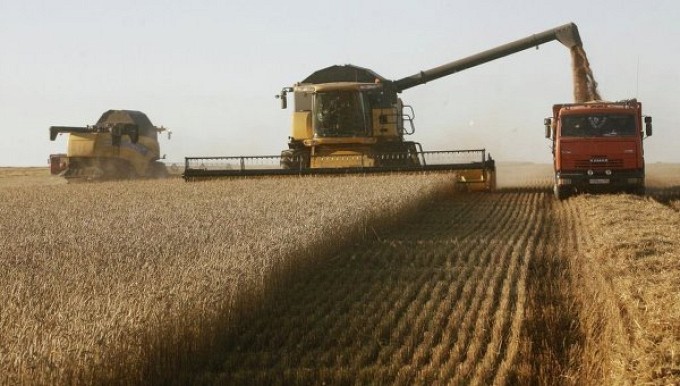
An expanded board meeting of the Ministry of Agriculture was held, chaired by Minister Aidarbek Saparov. Key topics included the pace of the harvest campaign; the availability of financing, machinery, fuel, and fertilizers for farmers; the intake of new grain by elevators; and the formation of the resource base for the 2027 season.
The meeting was attended by heads of the Ministry’s subordinate organizations and structural divisions, deputy regional governors (akimats), and heads of regional agriculture departments and territorial units of the agency.
Aidarbek Saparov noted that the primary objective is to complete the harvest campaign without disruptions, ensure the preservation of the crop, and simultaneously avoid falling behind in preparations for the upcoming season.
"All necessary resources have been mobilized: financing is secured, the machinery fleet is being updated, supplies of diesel fuel and fertilizers have been organized, and grain storage facilities are ready. Regional authorities must ensure coordination and promptly resolve any issues that arise," the Minister emphasized.
This year, crops were sown on an area of 24.2 million hectares, including 15.6 million hectares dedicated to grain and leguminous crops.
According to Vice Minister of Agriculture Nazgul Khatepova, grain has been harvested from 10.9 million hectares, representing 70% of the total harvest area. The grain yield stands at 15.5 million tonnes, with an average productivity of 14.1 centners per hectare.
The harvesting of oilseeds is also proceeding at a rapid pace: 1.3 million hectares have been harvested, yielding 1.3 million tonnes of oilseeds at a rate of 9.7 centners per hectare. Additionally, 2.6 million tonnes of vegetables, 1.9 million tonnes of melons and gourds, and 1.8 million tonnes of potatoes have been gathered. These volumes are sufficient to meet domestic food market needs. Under the concessional lending program for spring field and harvesting operations, applications from agricultural producers totaling 664.4 billion tenge have been financed.
The technical modernization of the sector is ongoing. Under the concessional leasing program, over 7,500 contracts have been concluded for the supply of approximately 8,600 units of machinery, with a total value of 288.1 billion tenge.
In total, since the beginning of the year, contracts for the supply of 10,774 units of machinery worth 353.9 billion tenge have been signed through KazAgroFinance JSC under active leasing programs.
The harvest campaign involves more than 130,000 tractors, 29,000 grain harvesters, 17,000 reapers, and approximately 130,000 other pieces of machinery. This includes over 12,700 tractors and 2,340 high-performance harvesters acquired through concessional leasing programs operating in the fields.
Regions have been allocated 401,000 tons of concessional diesel fuel at a fixed price.
Alongside the harvest, the resource base for the upcoming agricultural season is being established.
The mechanism for early financing of the 2027 sowing campaign will continue in 2026. In this regard, regional administrations (akimats) have been instructed to ensure that agricultural producers timely fulfill their obligations to financial institutions.
The formation of the seed stock is underway; 1.4 million tons of seeds have already been secured, representing 61% of the required volume. Two million tons of mineral fertilizers have been shipped.
The country's total grain storage capacity stands at 30.5 million tons, comprising 13.1 million tons at licensed grain-receiving facilities and 17.4 million tons at facilities owned by agricultural producers. Existing storage capacity is sufficient to accommodate the new harvest, including carry-over stocks. According to the Qoldau digital portal, licensed grain storage facilities are operating at approximately 30% capacity, holding 4 million tonnes.
Since the arrival of the new harvest began, licensed grain receiving facilities have accepted 4.3 million tonnes of grain—double the volume recorded during the same period last year.
The breakdown of accepted soft wheat shows that 61% is Class 3 grain, 34% is Class 4, and 5% falls into Class 5 or the "unclassified" category.
Following the board meeting, the Minister instructed regional deputy governors to intensify daily monitoring of the harvest campaign, ensure the accuracy of reporting, and promptly address issues faced by farmers.
"The harvest campaign must be conducted in an organized manner, without disruptions, and with maximum efficiency," Aidarbek Saparov concluded.