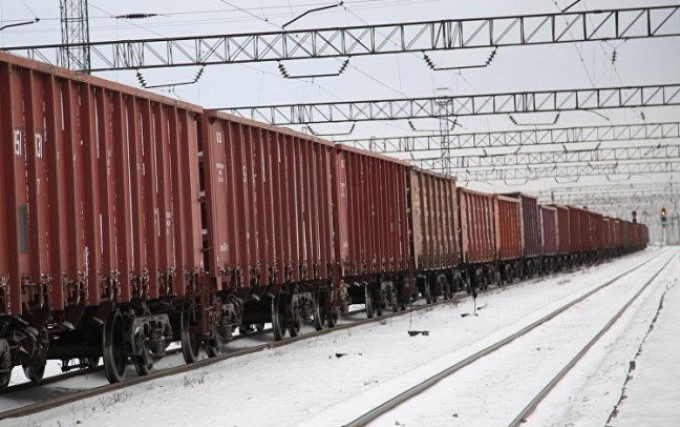
National company KTZ expressed its willingness to consider priority loading for certain types of cargo (vegetable oil, flour, and milled products), as well as waive fines for railcar demurrage on public tracks and failure to fulfill transportation plans, APK News reports.
The main news of the week is that JSC NC KTZ has once again imposed a ban on the loading and clearance of all cargo, with the exception of perishables, from December 2 to 10, bound for Afghanistan, Uzbekistan, Kyrgyzstan, Tajikistan, and Turkmenistan via the Saryagash International Grain Transfer Point. This was announced by Yevgeny Karabanov, Head of the Analytical Committee of the Kazakhstan Grain Union, in his weekly report.
As stated in the order, "in order to stabilize the train situation and prevent disruptions to the transportation of socially important freight..., due to the large backlog of wagons and the untimely acceptance of trains by neighboring railways in the direction of the Saryagash railway station of more than 11,500 wagons, which exceeds the standard capacity of more than 5,000 wagons and leads to congestion and train delays..."
Furthermore, "due to the backlog of wagons on the KTZ network, the assignment of more than 6,500 wagons to stations of the Almaty branch of the state enterprise, including 950 grain wagons, which exceeds the standard capacity of more than 1,500 wagons... the acceptance of grain cargo (wheat, barley, buckwheat, legumes), milled products (bran, feed flour), and compound feed from all KTZ stations destined for the stations of Aksenger, Burundai, Baiserke, is prohibited." Zhetysu, Zhetygen, and Kapchagay to all recipients (except for Alel Agro and Agrofit at Kapchagay station) from December 2 to 11, 2025, inclusive...
Also, "due to the unstable reception of container trains carrying grain cargo by China Railways through the Altynkol border crossing and the presence of more than 175 container trains in operation, which exceeds the standard capacity by more than 120 trains, including 23 trains temporarily suspended,... the acceptance and rerouting of grain cargo in container trains destined for China through the Altynkol border crossing is prohibited from December 2 to 10, 2025..."
A large number of primary and additional plans for December have been rejected, noted E. Karabanov.
At a meeting held last week with officials from KTZ, the Ministry of Agriculture, the Atameken National Chamber of Commerce, and industry associations, the issue of the duration of the restrictions and the cargoes they apply to was raised.
KTZ officials noted that cargo clearance for the Saryagash railway will be carried out in accordance with the technical capabilities of the KTZ and UTY infrastructure.
"At the same time, KTZ expressed its willingness to consider loading priority for certain cargoes (vegetable oil, flour, and milled products), as well as to waive fines for wagon demurrage on public tracks and failure to fulfill transportation plans," said E. Karabanov.
Therefore, he also noted, wheat export prices have become largely nominal and declarative. However, wheat prices have increased:
▪ Class 3 with Class 23-24 by USD 3/t;
▪ Class 3 grain (Class 25-26) by USD 2/t;
▪ Class 4 grain by USD 3/t;
▪ Class 5 grain by USD 2/t
Meanwhile, the increase in export prices also affected wheat flour, rising by USD 2-5/t.
"The increase in export prices for wheat and wheat flour is due to the strengthening of the tenge and the current shortage of goods among importers due to loading restrictions," the expert commented.
Barley export prices remained unchanged.
Summing up, Evgeny Karabanov noted that demand for wheat remains constrained by railway capacity. This is leading to a shortage of grain and flour in traditional markets and an increase in export prices. Demand for barley from Iran is supporting domestic prices.