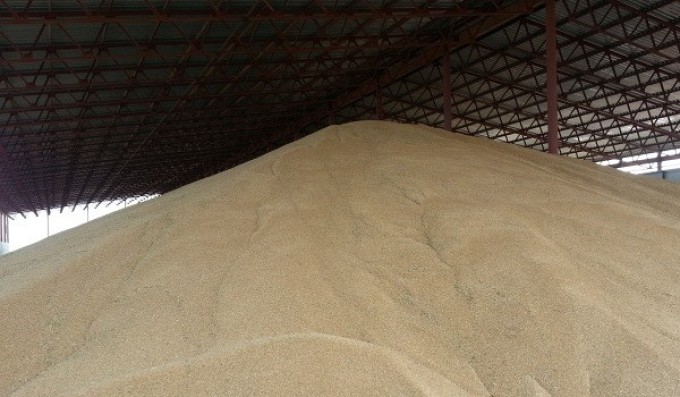
As of November 1, 2026, the total volume of grain and leguminous crops in Kazakhstan reached 19,578,000 tonnes, according to data released by the Bureau of National Statistics of the Republic of Kazakhstan. The bulk of these stocks—16 million tonnes (82.2%)—consists of food-grade grain, while 2.4 million tonnes are designated as animal feed, and 1 million tonnes are set aside as seed stock, reports the news agency APK Novosti.
Composition of Stocks
Wheat remains the primary crop in storage, with an estimated volume of 14,602,000 tonnes (accounting for nearly three-quarters of the total volume of grain and legumes). The vast majority of this wheat—13,159,800 tonnes—is classified as food-grade, while 810,100 tonnes are for seed and 632,100 tonnes are for animal feed. Within the total wheat inventory, soft wheat varieties account for 14,053,700 tonnes, and durum (hard) wheat accounts for 548,300 tonnes (of which 497,300 tonnes are food-grade).
Barley is the second most significant crop, with stocks totaling 2,965,600 tonnes (comprising 1,529,800 tonnes of food-grade, 1,268,200 tonnes of feed-grade, and 167,700 tonnes of seed stock). Other notable volumes include maize (corn) at 507,500 tonnes—predominantly feed-grade (327,100 tonnes)—and rice at 313,500 tonnes (of which 305,200 tonnes are food-grade). Stocks of niche and cereal crops are distributed as follows:
Oats — 250.7 thousand tonnes (including 126.3 thousand tonnes for feed and 111.2 thousand tonnes for food use);
Buckwheat — 75.6 thousand tonnes (69.1 thousand tonnes for food use);
Mixed cereal grains — 30.6 thousand tonnes;
Rye — 28.8 thousand tonnes;
Millet — 22.9 thousand tonnes.
Regional breakdown: concentration in the north
An analysis of regional distribution reveals a high concentration of grain resources in the three primary grain-growing regions of the northern belt. Together, these account for 15,122.7 thousand tonnes, or 77.2% of the country’s total stocks:
Akmola Region — 5,578.4 thousand tonnes;
Kostanay Region — 5,045.9 thousand tonnes;
North Kazakhstan Region — 4,498.4 thousand tonnes.
Among other regions, significant volumes are held in the Karaganda (986.8 thousand tonnes), Pavlodar (806.5 thousand tonnes), East Kazakhstan (463.6 thousand tonnes), West Kazakhstan (447.4 thousand tonnes), Aktobe (384.8 thousand tonnes), and Kyzylorda (333.5 thousand tonnes) regions. In the remaining regions, stocks range from 237.3 thousand tonnes in the Zhetisu Region and 228.8 thousand tonnes in the Almaty Region to minimum levels in Ulytau (6.6 thousand tonnes) and the Atyrau Region (434 tonnes). In the major metropolitan areas, stocks stand at 76.3 thousand tonnes (Shymkent), 17.3 thousand tonnes (Astana), and 1.5 thousand tonnes (Almaty).
Foreign Trade: Exports Outweigh Imports Fivefold
An abundant supply of domestic raw materials allows Kazakhstan to maintain its status as a grain exporter. From January to August 2026, external shipments of key crops significantly exceeded import volumes.
Wheat and meslin remain the primary export commodities: over the eight-month period, 5,515.1 thousand tonnes were shipped abroad, while imports totaled 1,185.2 thousand tonnes (with exports exceeding imports by a factor of 4.6). A similar trend is observed for barley, with 684.8 thousand tonnes exported against 124.8 thousand tonnes imported.
Legumes and niche crops also show high export activity:
Dried legumes (lentils, peas, chickpeas): exports reached 309.4 thousand tonnes, compared to 36.4 thousand tonnes in imports (for fresh or chilled legumes, 2.7 thousand tonnes were exported, while 1.3 thousand tonnes were imported);
Corn: 137 thousand tonnes exported, 24.2 thousand tonnes imported. Rice: 99.3 thousand tonnes shipped to foreign markets, while 5.9 thousand tonnes were imported;
Buckwheat, millet, and other cereals: exports reached 23.4 thousand tonnes, compared to 12.8 thousand tonnes of imports;
Sorghum: 191.6 tonnes exported, 51.1 tonnes imported.
A negative foreign trade balance was recorded for only two niche categories with limited domestic production: oats (4.7 thousand tonnes exported versus 27.7 thousand tonnes imported) and rye (204 tonnes exported versus 14.1 thousand tonnes imported).
Thus, the current grain balance (nearly 19.6 million tonnes as of early November) fully covers Kazakhstan’s domestic requirements for food grain, seeds, and animal feed, leaving an export potential of approximately 10–11 million tonnes for the current marketing year. Furthermore, the fact that food-grade wheat accounts for 90% of total wheat stocks indicates a sufficient supply of marketable grain for the flour-milling industry and for export markets.
However, the concentration of nearly 80% of all stocks in three northern regions—coinciding with a shift in crop diversification toward oilseeds—places increased strain on transport and grain-storage infrastructure. Given that the country has already imported 1.18 million tonnes of wheat over the past eight months (primarily for cross-border processing and re-export), the key factors influencing pricing during the winter and spring will be the capacity of railway corridors and the tariff policy applied to shipments destined for Central Asian countries and China.